Liminal RPG : Spirit Traits

Some time back I purchased a copy of Vaesen, written by Johan Egerkrans, its a stunning collection of his illustrations depicting the spirits, fairies and other supernatural creatures from Scandinavian folklore alongside some interesting background about these beings, their personalities and abilities. This material is a great inspiration for fantasy scenarios and of course it’s no surprise that an RPG based on this book soon followed from Modiphius, who are coincidentally also the publisher of the Liminal RPG.

What struck me reading the entries is that the spirits themselves have some abilities which are not readily represented by existing Traits in the Liminal RPG, notably their ability to control reality within what might be called their sphere of influence. House spirits such as Nisse or Tomte, are quite powerful in their ability to protect dwellings and farms, but they and their powers are limited by being tied to those locations. There are also spirits or forests, pools, mountains and the like who have varying powers and influence but again they are tied to specific locations in the world.

It’s worth noting that the extent and power of a spirit’s abilities is not linked to the size of its domain. A house spirit could be very powerful but might only command these abilities within the confines of a single dwelling whereas a river spirit/god might be more passive, with more subtle powers, but with an influence over a much greater geographic area.

Though there are plenty traits in the Liminal core book that can be used to represent the powers of a Spirit, I felt that there was merit in a specific system to capture some of their unique abilities. Also, as one of the major NPCs in my campaign is a powerful local spirit (and I have a few more planned) I wanted to explore their powers in a little more detail.

“Sir, what you had there is what we refer to as a focused, non-terminal, repeating phantasm or a class-five full-roaming vapor. A real nasty one, too.”, Ray Stantz, Ghostbusters.

My take is that Spirits are a separate class of entities from the Liminal beings already outlined in the game so a framework might be useful to the Game Master for creating such entities, and I hope the information provided here will do the trick. I would avoid being slavish to this guide though, Spirits do and should definitely have abilities that are unique and unusual, and it is vital that PCs are not able to simply catalogue or pigeonhole these beings. Familiarity breeds… well, maybe not contempt, but it takes some of the magic out of the game if Spirits are simply reduced to a couple of well-known Traits.

Decades ago when my gaming group first started playing Call of Cthulhu, everyone read through the section on the Mythos gods and races, and I think in the subsequent games they were not as powerfully alien or horrific due to our over-familiarity with the monsters we were facing.

In this post I have tried to provide a basic system for presenting the powers of spirits from small house spirits – genius loci – such as the Brownies, Tomte or Kobolds, through to medium powered entities like Naiads up to city river and mountain spirits such as my own Maister of the Old Toun, Nikar and also the River God Temese in Pax Londinium.

Fae Lords & Ladies
It’s worthwhile making a quick aside to look at the the slightly blurred definitions between major Spirits and the more powerful Fae. My view is that the main distinction lies with a Fae’s powers being tied to their realms, whereas Spirits derive theirs from the nodes and Ley Lines within the real world. I assume that some Fae are happy to be considered akin to powerful Spirits as a matter of vanity and pride.

Lastly, a further confusion it that term, spirit, could also refer to Ghosts and the souls of the undead, clearly they are different sort of entity and are not covered here.

Aetheric Traits

Powered by qi, aura, prana, mana, élan vital, etc, spirits have powers that are multifarious, ambiguous and potent. House spirits can banish intruders, spoil milk, curse the rude and protect the inhabitants of the home to which they belong. River and Lake spirits can grant safe passage, whisper truths they have seen or, drown the unwary in freak currents and tides. It’s not in the scope of this post to cover what Spirits are, how they came about or, how they draw on this power. I have my own thoughts but perhaps it is best left as a mystery for the players.

There are two primary Traits which define the extent of the Spirit’s powers: Domain/Demense, which represents the extent of reality the spirit can influence and Power/Vires, which is a measure of it’s force or ability to affect that same reality. I will use both names for these traits throughout, e.g., Domain and Demense, with one being common usage and the other being the more academic term used by magicians.

Note that the two traits are not linked, so a House Spirit with a 1-point Domain, the home it protects, might have a Power of 3 or 4 representing it’s ability to ward against invaders, repair damage to the home and keep the hearth burning. A sleeping or forgotten mountain Spirit (Demense 3) might only have Vires at 1-point representing it’s dwindling strength and influence.

Domain/Demense (1-5 points)

A Spirit’s demense is a rating of the extent of it’s control and a limit to how far it can travel – Spirits are bound to their Demense and can only move out of it in exceptional circumstances.

  • 1-point trait would indicate that the spirit is bound to a small area, perhaps a house, small copse of trees, a forest clearing or a spring-head.
  • 2-points : A Spirit of a wood, hill, lake island, stream, village or henge.
  • 3-points : A Spirit of a town, forest, mountain, medium-sized tributary, lake or swamp

Only Spirits of great power would merit a 4- or 5-point Demense which would represent great mountain ranges, large islands, cities and large rivers; and of course whole countries or large geographical areas such as deserts, tundra and continents. Few spirits of this size exist and most are in a dormant state.

Within it’s demense the Spirit is aware of almost all things happening, and by focusing it is able to sense magical effects or creatures, sense the movement of mundane creatures or people, detect temperature changes and movement or destruction of natural items with a simple Awareness roll. The difficulty set should consider what is being sought, with commonplace events being harder than rare events, individuals or objects.

Substantial damage to the Spirit’s demense can cause this Trait to drop in value, as well as likely angering the spirit in question. Complete destruction of the demense such as uprooting or felling all the trees in the wood or burning down the house will cause the Spirit to become unbound, effectively removing it from world and leaving to drift through reality until it can bind itself to another location. What happens to the unbound Spirit is beyond the scope of this post but perhaps could be the source of an investigation or trigger for larger events in your game world.

Power/Vires (1-5 points)

Vires acts like a Skill Cap for spirits so any additional Traits assigned by the GM either from the Rule Book or from the option below cannot exceed this value.

Vires acts a cap on the limit but not the total number of Traits so a spirit with a Vires of 1 can have as many 1-point Traits as the GM deems necessary. As Spirits are NPCs it is left to the GM to decide which Traits are appropriate. Note that some Traits would not suit the spirit itself e.g. Supernatural Strength, but these could be assigned to the Avatar/Incarnate, see below.

For example, if a GM wanted to grant the 2-point Geomancer magical Trait (Liminal pg. 96) to the spirit they are creating, it would need to have a Vires of at least 2. If the GM wanted to add the Geomancy extra effect, My Enemies are the Land’s Enemies, their Vires would have to be a minimum of 3 – the total cost of the that Trait and specialisation. Subsequent specialisations would require a higher Vires score.

Will & Spirits
Spirits have a base Will of 10 plus their Vires score. If a Spirit’s Will drops to zero for any reason it will lose one point from it’s Vires Trait permanently, and obviously they want to avoid this happening. Loss of Vires is usually enough to cause a Spirit to flee the source of attack or dismiss its avatar.

To recover it’s Vires Trait rating the Spirit needs to expend 10 x the lost level in Will. For example a Spirit whose Vires has dropped from 3 to 2 would need to expend 30 Will for it’s Vires to rise again to 3. This expenditure does not have to be spent at one time and the Spirit can spend a few points a day to gradually recover its strength.

Recovering Will

Spirits spend Will to activate their Traits as normal but they recover Will slightly differently. By drawing on the energy of their Demense they gain Will points equal to that Trait plus D6 per day. The Tomte example below would recover D6+1 Will points per day from it’s tiny patch of reality.

Tomte

A Tomte or Nisse is a small Scandinavian household spirit which could be represented with the following Traits, spending the recommended spend of 10 – making it a formidable opponent for any would be house-breaker, but one who can only affect the world in the immediate vicinity of its home.

Aetheric Traits* – Demense (1), Vires (4)

Magic Traits – Blessing & Curses (2) [Under My Protection]

Exceptional Abilities – Animal Sense (1), Brawny (1), Countermagic (1), Quick Reflexes (2).

Automatic Abilities*– Night Sight (1), True Sight (1)

Spirit Traits – Avatar (2)

Will – 14

*These are not included in the Trait Limit

GÅRDSTOMTEN by Johan Egerkrans
www.johanegerkrans.com
GÅRDSTOMTEN by Johan Egerkrans

Spirit Traits

As noted above Spirits can be assigned almost any Trait in the rule book but GMs are encouraged to use a bit of common sense – a lake spirit is unlikely to have Vehicle Wizard or Big Business for example, whereas Healer or Presence might be appropriate.

Automatic Traits

Spirits have the following Traits due to supernatural nature; Night Sight and The Sight.

Assigning Trait Points

The GM should just assign as many Traits as they think the Spirit requires for their needs but as a rule of thumb limit the Trait points to the (Vires+Demense) x 2, and Aetheric and Automatic Traits do not count towards this limit. Spirits can take the NPC Traits such as Monstrous Toughness (pg. 219) but many will only be applicable to their physical form.

Spirits cannot directly interact with other entities unless they have an Avatar, however they can make their presence felt by altering the weather or causing other effects, giving them equivalent of Geomancy Traits (Danger Sense and My Enemies are the Lands’ Enemies) and the Weathermonger Trait to a limited degree for manipulating the air and temperature close to the ground. So fog and frost are possible, lightning and hail storms are not.

Additional Traits for Spirit NPCs

Below are Traits which are specific to spirits:

Avatar/Incarnate (2 point)

The Spirit can create a physical form for itself out of magical energy giving it a body to interact with the world. The avatar will have a fixed form and will be visibly non-human unless it also possesses Glamour traits to enable it to mask its true shape further. Spirits vary widely in their appearance but are heavily influenced by the nature of their Domain.

The GM should assign Skill points noting that they tend to be few in number with Awareness, Lore, Charm and Taunt being commonly taken. The focus should be on Physical and Social skills.

Skill Points = 20 + (Demense & Vires)
Endurance = 12 + (Demense and Athletic skill)

Destroying a Spirit’s Avatar, causes a permanent loss of 1 point of Vires which much be recovered. Creating an avatar costs 2 Will per day.

Suggested traits for avatars: Animal Sense, Frightening, Healer, Night Sight, Presence, Quick Reflexes, Rage and Sneaky. And from the NPC traits: Appear Human. Faerie Tongue, Immaterial, Invisibility, and Monstrous Toughness.

Anger of the Earth (1 point)

This is functionally the same as My Enemies are the Land’s Enemies (pg 96), however the range is limited to within the Spirit’s domain. The Spirit spends 1 Will to make the attack. Optionally, spending 2 Will to attack causes D6+Vires damage on a successful strike. Note that this attack can damage the local environment, so Spirits will use it sparingly.

One with my Domain (1 point)

While all Spirits have an innate connection of their domain, they are not fully conscious of what happens within it at all times, excepting when an unusual event occurs. With this trait the Spirit maintains a vivid. constant awareness of all that occurs in their domain. Traversing their domain without being noticed is impossible without magic. This costs the Spirit 2 Will per day to maintain.

Blessings of the Land (2 points)

The Spirit creates an pleasant idyll in their domain which is a place of safety and healing for friendly visitors. The nature of the place depends on the Spirit itself: this might be a small, sheltered, sunlit clearing in a forest; a clear, warm, pool next to a river; or a stone circle in the land. As well as being a place of refuge, engendering calm and peacefulness – visitors in the idyll recover D6 endurance per hour, and never feel hunger or thirst. Time flows differently in these places and characters must make an opposed Will test against the Spirit’s Power when they wish to leave – some people never choose to.

The Spirit must spend 2 Will per day for each such place it maintains.

Rage of the Land (2 points)

Part of the Spirit’s domain is hostile to human life and usually this is a location where extreme weather conditions occur. In such places, characters without proper, relevant equipment suffer D6 endurance per hour, and must make Will tests against the Spirit’s Power per hour or be forced to turn back to safety. Commonly such places would be mountain ranges where howling winds drives ice and snow at climbers. However, other natural hazards such as swamps, whirlpools, riptides, desserts, entangling or thorned foliage, and deep jungle are all possible alternatives.

The Spirit must spend 2 Will per day for each such place it maintains.


I hope that the above is of interest, I am sure that there are more Spirit specific traits that can be developed, but there is enough there to create a range of these beings to populate your Liminal world.
Standard

The Enlightened Brotherhood

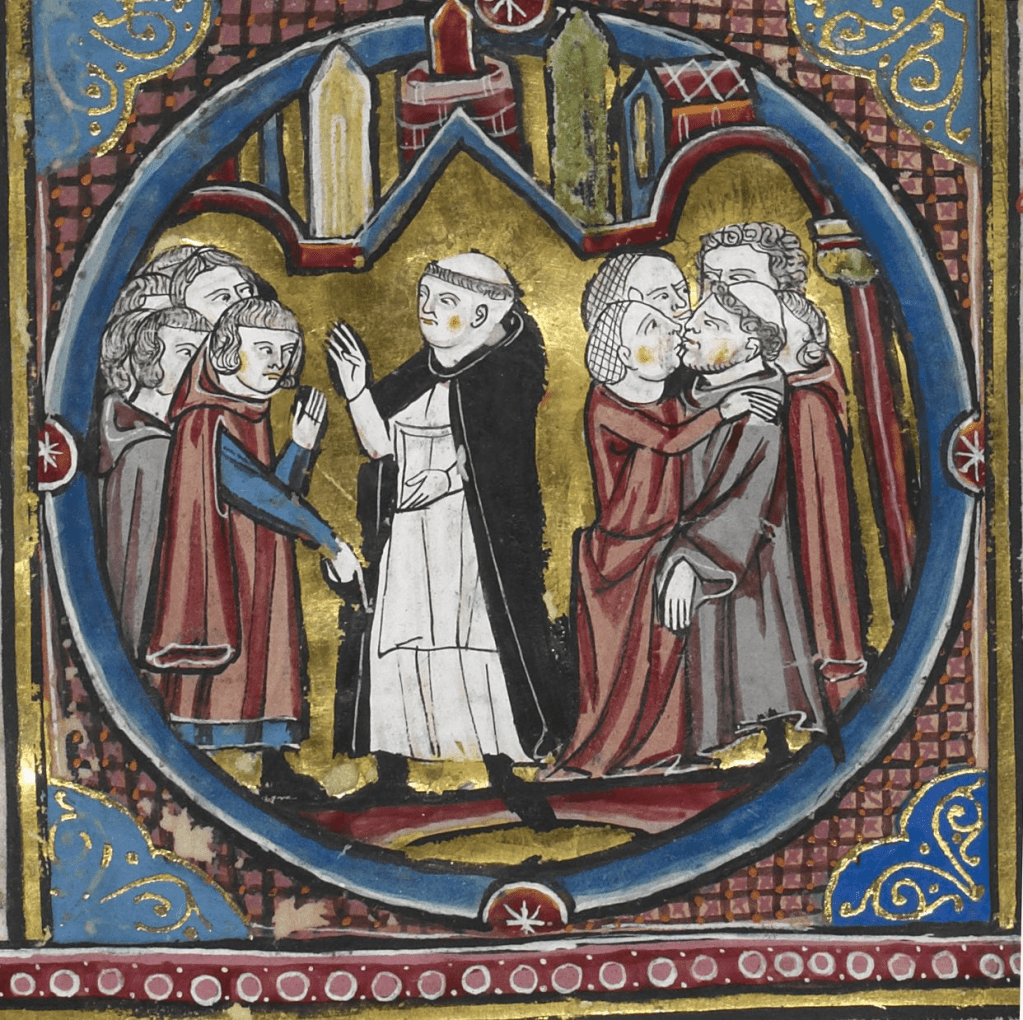
Cropped image from an illuminated manuscript featuring some monks or priests meeting

In an earlier post I detailed my plans for a Liminal campaign set in Edinburgh but I haven’t expanded on my background material in far too long, so this is post in an attempt to kickstart the brain juices and lay the groundwork for the next scenario which I am developing.

Since my last post I have ran a short scenario for my gaming group, The Case of the Craiglockhart Hydra, which dealt with a haunting at a college campus in the city. It was a purposefully short scenario and included several options for the players to reach a resolution, my goal being to make it simple and self-contained enough to run at a convention. Ultimately, my players took a couple of nights to complete it, too long for a convention game, but I am hopeful I can make a few tweaks to fix that. I’ll write it up in a future post as I am pleased with the story and themes, which draw upon both local Edinburgh and wider British history. I hope that despite its local scope, it has a wider appeal and I am sure it can be readily adapted to other British locales if desired.

Liminal Edinburgh

My work in progress scenario will introduce some of the other groups inhabiting the Liminal world in Edinburgh and in this post, I will expand on my previous brief description Enlightened Brotherhood, a small, secret magical society, and cover the knowledge the PCs would know, or could simply find out about this organisation.

The Enlightened Brotherhood

While relatively well known to Liminals in Edinburgh, this secretive magical society has little impact or recognition outside of the city. The Order of Merlin is certainly aware of them and the two groups are officially on cordial terms but in reality they interact with each other only rarely. While the Order of Merlin sees its role as the preeminent magical society in Britain, seeking to wield power and influence to get their way, the Enlightened Brotherhood are far more bookish, un-engaged and passive. While not being completed removed from events, their apparent weakness, low numbers and studious neutrality mean that they are rarely a factor in Liminal politics.

The Order of Merlin should technically consult with the Brotherhood on any actions their organisation takes in Edinburgh, but they rarely do, apologising as an afterthought if they have obviously transgressed.

To most of the Hidden World, the Brotherhood seems to be a clannish group of slightly obsessed geomancers who are occasionally spotted working their magic near the main nodes in and around the city. As they only rarely participate in the affairs of Liminals, this does mean that when they make an appearance it is of intense interest to some of the key players and factions in the city.

History of the Brotherhood

As you would expect from such a secretive group, little is known of their true history beyond what passes for common knowledge in Edinburgh. They are claimed to have their roots in the Speculative Society of the mid-18th century but that is contested, and one Fae Lord has claimed that “these middlesome, twistit warlocks have pestered our lands since the time of King James”.

Whatever their origin, they mages that became the Brotherhood came to prominence from the 1760s onwards, taking a keen interest in the creation of Edinburgh’s New Town, promoting it’s development, and providing their expertise as surveyors with exceptional local knowledge. It is long rumoured that they were able to apply a lot of influence to the young James Craig on the alignment of the roads in this grand development, both in the initial proposals to the Lord Provost and latterly when work was started.

Fearing any further encroachment out of the city beyond the cramped Old Town would be a threat to their realms, the local Fae resisted urbanisation plans to the north of Edinburgh as well as growing expansion to the south. As the Nor and Borough Lochs were drained their worst fears were realised when one entrance to the Fae realm located at St Bernard’s Well vanished where cobbled streets were laid down. This ancient locus and several other nodes outside of the city were quickly lost and tensions rose between the Fae and the Brotherhood, with most people foreseeing a major conflict between them as inevitable. In an effort to prevent bloodshed, both sides were called to a meeting by the Maister, and representatives attended a conclave held on Arthur’s Seat at Samhain of that year.

Surprisingly, an agreement was struck by daybreak as the Covenant of the Fae conceded their lost nodes in return for peace with the Brotherhood. None of those present at the meeting have revealed what led to the deal being reached so quickly and on terms so favourable to the mages. To this day, it is still a topic of great speculation whenever the Brotherhood come up in conversation. What on earth made the local Fae, who are as proud, vicious and powerful as any of their race, agree to give up their lands? Did the Brotherhood promise something greater in return? Did they threaten the Fae and if so, what with?

Whatever the actual circumstances of the deal were, no one who was there is talking about it now, and presently both groups are coolly polite to each other.

The Present Day

The Brotherhood are thought to now number around four individuals with perhaps a dozen close allies, including a few Wardens. Their agents have close ties to the local universities, some Government agencies, and private members clubs, though as noted they keep apart from the rest of the Liminal world and whatever their plans are, no one seems to know.

Key Individuals

Vincent Saint

A slightly built and balding man in his 50s/early 60s, Vincent is impeccably dressed in expensive suits, typically in dark shades of green. Little is known of his background and although he has a Home Counties accent, there is a trace of French in his speech , but neither has provided a clue to his origins. He is unfailing polite but is dedicated to protecting the Brotherhood and keeps its secrets at all costs.

Vincent will often look for agents he can use to perform investigations while letting the Brotherhood itself remain at arm’s length from any trouble. He is a valuable source of lore, and his colleagues have many magical resources despite their small size.

  • Drive: Keep your secrets, investigate new nodes
  • Physical Skills: Awareness 4
  • Mental Skills: Art 2, Education 5 (Specialisation Mathematics), Lore 4 (Specialisation Nodes),
  • Social Skills: Charm 2, Conviction 4, Empathy 2, High Society 2
  • Traits: Bookworm, Countermagic, Rich, Geomancy (Danger Sense, My Enemies are the Land’s Enemies, One with the Land, Sense of Eyes, Tap Power)
  • Endurance: 7
  • Willpower: 13
  • Damage: d6

Standard

Maister o’ the Auld Toun

A Liminal Crew Patron for an Edinburgh setting

https://whitechapelwitch.tumblr.com/post/106589806391/x

As I mentioned in my previous post, I wanted to pull together some background material for my Edinburgh-based Liminal setting with the focus being on some of the main NPCs and factions I felt the Crew would know about given their involvement in the Hidden World of the city.

The first of these NPCs is a mostly-benevolent city Spirit whose domain is centred on the Old Town of Edinburgh, an area loosely defined by the limits of the Flodden Wall. This NPC will be the main Crew patron in my setting so I have provided a more detailed background to support this important role he will have in the campaign.

History

The Spirit that would become the Maister o’ the Auld Toun or, simply The Maister, has been present on the Castle Rock long before the early inhabitants of Scotland settled on this craggy volcanic plug.

It had been worshipped directly at various times in prehistory but by the time the Romans came to the Lothians, a pantheon of Gods had taken precedence for the inhabitants of the hillfort of Dun Eidyn and the spirit drifted into legend, even amongst the Fae.

As the medieval city of Edinburgh grew the Maister reawakened, perhaps by the incessant human digging into the Castle Rock and began again to make its presence felt. This time though, it was less connected to the rock itself and more attuned with the town and its inhabitants, becoming almost the personification of Auld Reekie and a city spirit in all but name.

Over the next half-millennium, he took on a protectionist and paternalistic role, keeping the Old Town’s inhabitants safe from supernatural threats while attempting to remain as neutral as possible with the other Liminal factions. His powers held many of the doors to the ghost realms beneath the city closed, keeping the monstrous regiment of the angry dead from attacking the living. He also stopped attempts by geomancers to tap the many the nodes in his domain, appearing to them directly and driving them off, or using his allies amongst the Liminals to do the same.

During this time, he accumulated a number of nicknames, these are mostly archaic now, but are still used in derogatory terms by his enemies: Laird o’ the Luckenbooth, The Lumheid and Keek-the-Wynd.

In the last few centuries though his power has begun to dwindle. This is most evident in wintertime, or Samhain, when he is uncommunicative rarely visible. On the shortest days of year Edinburgh’s dimly lit and narrow wynds become more dangerous as his protective wards weaken, the doors to the Ghost Realms begin to crack open and their inhabitants slip out to haunt the living. At this time of year even those without the Sight avoid the deep shadows of the vennels and keep to the busier streets with their modern lighting and the welcome chatter of the living.

At summertime/Beltain though he is at his greatest strength; in August, when the streets are thronged with Festival artists, visitors and tourists he is frequently seen wandering openly amongst mortals, often mistaken for a street performer or gangly stage actor and apparently delighting in the sights and sounds of the Fringe.

Appearance & Demeanour

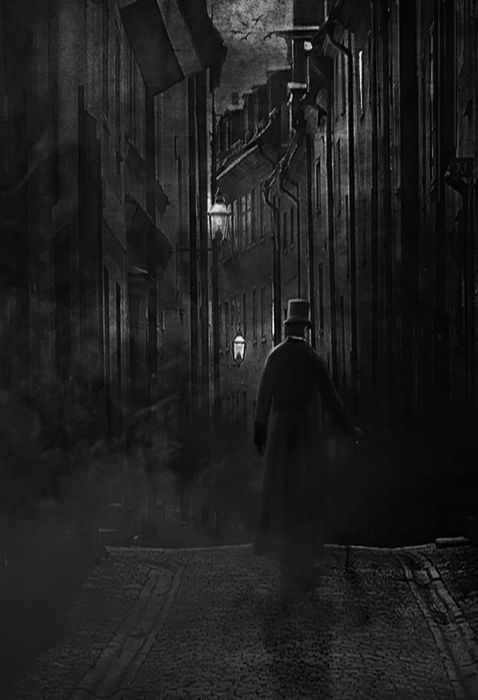
The Maister most commonly adopts the appearance of an unnaturally tall, pale and skinny man dressed in a soot-stained top hat and tails or, some equally grubby Victorian garb. In the Festival season he often appears as a mime artist, street performer or some other bizarre/interesting individual, inspired by whatever act he has watched recently.

He is a Spirit of few words, preferring instead to gesticulate elaborately with his spider-like fingers while using his wide-eyed, expressive face to convey his mood. When he does speak his voice is rather hoarse and quiet which is in contrast to his sharp, icy breath which can chill the air even on the warmest of days.

Base of Operations

The Maister has no particular base of operations in the city and is frequently seen on the streets by characters with the Sight who venture into the Old Town. He tends to avoid encounters in the street though, preferring to meet in the Angus Ogg pub, making his presence known when the Locked Room is opened.

The ‘Angus Ogg’ Pub

The Angus Ogg is one of the oldest, if not the oldest extant public house in Edinburgh. It is however almost completely unknown to the wider public: it does not appear in any guidebooks nor is it included in any tours, yet it is right in the midst of the busy Cowgate, a hotspot of student drinking dens. Only those who have been to the pub before or have been brought by someone who has, can gain access. Regulars wander down Dyer’s Close and if there is no-one else present, an intricately carved door made of unvarnished elm will appear in the wall and open at their approach.

Occasionally the door in Dyer’s Close opens to those not of the Hidden World for reasons that are not understood. These new patrons are often in a desperate situation and always in need of help and this is usually where the PCs come in.

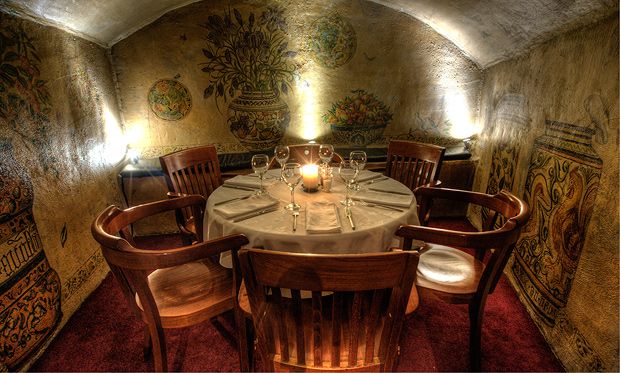
The interior of the Angus Ogg is not significantly different from many of other vaulted underground pubs in Edinburgh with its bricked, curved roof and slightly damp, mouldy air. What does set it apart is its lack of modern conveniences – it is illuminated by a gas lighting whose copper pipes are much in evidence and there is a complete absence of any electrical equipment.

There is a good dozen hand pulls on the large wooden bar offering a variety of beers but most of them will be unfamiliar: Ushers 80/-, Bernards Pale Ale, Drybrough Heavy, etc. The source of these beers from long vanished breweries remains a mystery but the cellar is always well-stocked. Spirits and wine are available and poured from unmarked, corked, clay or glass bottles of indeterminate age. The Angus Ogg never offers food though regulars do bring in their own and the occasional smell of a fish supper or takeaway pizza fills the room on busier nights. The numerous nooks and corners are filled with an eccentric collection of tables and chairs, some are barely functional, but others are obviously of great age and evident value.

The staff of the pub are all Liminals of one description or another, usually outcasts and the lost such as newfound Changelings trying to find their place in the world.

The Angus Ogg’s customers are always those that have glimpsed the Hidden World and need a place of solace on neutral ground or, to relax knowing that their safety is assured. Albert and the staff take the sanctity of the pub seriously and anyone causing trouble is swiftly barred, a rebuke which also carries social consequences with the local Fae.

Behind the bar there is the office, occupied most of the time by Albert, a clockwork man of unknown origin Albert is the acting manager, but he also plies his own trade offering customers intricate tattoos or making fabulous clockwork automata. He was found in the Locked Room some decades back and has remained in the pub since then, rarely venturing out where his large and oddly shaped frame can draw unwelcome attention.

The door to the Locked Room is covered with otherworldly carvings reminiscent of the Apprentice Pillar at Roslyn Chapel. Sinuous designs evocative of Fae or Pictish art overlay clearly biblically inspired motifs. It has no obvious handle or fastening and remains closed until the Maister wishes otherwise and has resisted all magical and mundane attempts to open it. The interior of the Locked Room appears to be the study of a madman and is filled with books, odd paraphernalia, junk and copious quantities of dust. If present, the Maister can be found here reading or puffing on a clay pipe.

As always I welcome comments and suggestions on this post.

Late edit from one of my players – Tom – who suggested this NPC for the Angus Ogg.

Martin

The lonely Echo of a former pub employee who has yet to realise his fate.
Martin was once a rising star in Scottish & Newcastle Pub chain and was on track to be appointed as the company’s youngest area manager when he came tragically unstuck in a Grassmarket cellar in the early 1990s. A furious poltergeist who haunted the pub found the unscrupulous duty manager pouring unfiltered slops back into the 80 shilling ale and decided to make an example of him, pulling down a full keg onto his head.

Thirty years later, still sporting cargo trousers, turquoise shirt, bowl cut and clutching a Filofax, Martin’s ghost found its way to the Angus Ogg. With no real grasp of where he is, or what happened to him, he’s never in one place for long. In his current haunt he can be seen pouring over a ledger in the office, trying frantically to get the floats to balance or slamming down NVQ hospitality paperwork on the bar and bemoaning the slovenly appearance of the staff, the bar and the clientele. Visitors might see him smoking nervously at the end of the bar, fretting over an impending Area Meeting or muttering about ‘targets’.

He is tolerated by the staff who make the pretence of listening to him. On occasion they have caught him in the cellar furtively clutching a filtration kit, which he tries to conceal before dashing for the door.

Standard

Liminal: Edinburgh

Destruction of Carthage - illuminated manuscript

Despite having approaching 40 years of gaming experience I have never ran a game, or even played in a game set in my home town of Edinburgh.

It was never something that had ever occurred to me before but after my initial reading of the Liminal core book I was firmly decided that I wanted to set here. I was inspired partly because Edinburgh is referenced directly in the rules (see sections on the Edinburgh Enquirers crew, pg. 67 and the Aldermen pg. 147-148) and this made me think that for a contemporary UK-based game it would be enjoyable to play somewhere that is very familiar setting for to my playing group but tweaked to contain a supernatural aspect.

So why I have I never played in an Edinburgh setting before? There are a couple of reasons for this; firstly, many of the RPGs I enjoy playing do not have a contemporary setting, let alone one set in the UK. Alien worlds, fantasy or early 20th Century America are fine but 21st Century Scotland has never featured. Secondly, if you are looking for the escapism that RPGs offer, the mundane world right outside your front door is an unlikely place to find fun-packed adventure. Your mileage may vary of course but I my day-to-day life rarely features supernatural horrors.

I presented my idea of an Edinburgh-based Liminal campaign to my gaming group expecting push-back or disappointment because it was set in a too-familiar location, but the exact opposite was the case, they seemed very keen on the idea and set to work coming up with character ideas. The character generation system is very lightweight & straightforward so it was easy to realise the novel and interesting concepts my players had for their PCs. We also had a fun ‘session zero’ discussion about their base of operations (more on the Angus Ogg pub later), how their characters interacted with each other, and how they saw their connections to Edinburgh’s Hidden World.

All this endeavour and we have yet to play a single scenario!

This is one of the great things about Liminal – most people can have an innate grasp of the Hidden World without the need to consume a vast amount of preparatory material. There are enough urban fantasy books, films and TV series that players can draw on for inspiration that gives them a solid basis of what is possible as a character and what they might encounter in that world.

My aim is to run a couple of pre-gen scenarios modified for the Edinburgh setting to familiarise the group with the game system before I get underway with writing up my own ideas, of which I already have a couple.

Before I get underway with running scenarios in Edinburgh I wanted to provide my players with an idea of the movers and shakers in the city; who they are allied to and who they need to be wary of. I also need to provide them with a brief on how each of the main factions operate in Edinburgh, basically all information that their Crew would know.

Over the next few blogs I am going to go into detail on some of important NPCs and minor factions specific to Edinburgh within my campaign, notably:

  • The Maister o’ the Auld Toon – A spirit known to the inhabitants of the Castle Rock since the Iron Age and who has gone by many names over the centuries it he has interacted with the populace and the other local Liminal beings. He is viewed as a benign, subtle but elusive influence in the Hidden World, helping to keep the Old Town as safe a location as possible. The Angus Ogg pub is under his protection, offering a sanctuary within the Old Town to those in the Hidden World looking for solace or help.
  • The Spirit of the Water of Leith – Opinion is divided on whether there are two spirits or a single being with two aspects. The spirit that bides in the western end of the water is helpful, almost childlike and seemingly unconcerned by events in either world. It’s counterpart at the eastern end near the port of Leith is a different creature entirely; aggressive, defensive and argumentative. It is known to attack the unwary who approach it for information but can be placated with the corpse of a cat or cheap foreign rum.
  • The Enlightened Brotherhood – A society of geomancers with roots in freemasonry and the Speculative Society. They were influential in the creation of Edinburgh’s New Town, it’s layout allegedly linking and enhancing some existing local Nodes. They remain allied with the Council of Merlin but their influence is on the wane.
  • The Covenant – Edinburgh is the UK city with the largest amount of green space making it a haven of sorts for the Fae. The local realms are numerous but small and fractious. Slights and bickering spin out of control leading to frequent turf wars and intrigue. The larger realms representing Edinburgh’s hills and the ‘charmed circle’ of wells have a loose federation called the Covenant which they use to maintain some order and also to present a united front when they have to deal with the Winter King. The larger Fae realms are not above intrigues of their own and complex shifting of alliances can be hard to fathom and follow.
  • The Angry Dead – Though stories of unfortunate plague victims being walled into Mary Kings Close are just legend, Edinburgh’s old town is a great citadel to the dead and a vast Ghost Realm. For hundreds of years the cramped, brutal and unsanitary conditions of the Old Town and within its notorious basements and vaults were a great source of misery and untimely death. Now the restless spirits of these dead folk roam the Old Town in great angry swarms, sometimes coalescing at the portals to the Real World, desperate to vent their frustration on the anyone who strays into their domain. Thankfully Aldermen and knowledgeable Liminals can navigate the safe passages and avoid the places where the doors to the Ghost Realm are often open. There are also rumours of a number of ancient Ghosts who can bargained with to allow safe entrance.

The above is all a bit of a work in progress but it should form the basis of my Liminal setting. As always, I welcome comments and suggestions

Standard

Liminal Magic : Alchemical Servants

I had an idea for a new magical path covering the creation of artificial beings – a more palatable option than using cadavers as presented under Raising the Dead, an extra trait for Necromancy, see pages 100-101 of the rulebook. Coincidentally one of my players came up with the idea of a Liminal character who was a Clockwork Man, a Victorian mechanical artefact, who has a soul and a personality but who was created in some bizarre ritual in the 19th Century. I thought that this was too good an idea not to include in my campaign so readily agreed and I will cover him in more detail in another post.

Returning to the idea for a new magical path, there are a number of examples of magically created beings in literature and myth such the Jewish Golems, Alchemical Homunculi, Shelley’s Frankenstein’s monster, the Terracotta Army of Qin Shi Huangdi and I am sure countless others across a breadth of human cultures.

In essence, the magician is able to imbue lifeless, inanimate matter with some spark of life, perhaps even a soul, to create a powerful servant who can be commanded to do their bidding. The exact mechanism for this would vary according to the magical style of caster – with some perhaps sacrificing a portion of their own soul, others calling on a God to do so and still others trapping or persuading a free soul or spirit to inhabit the artificial body.

My thinking for the rules around this was that it should follow the Raise the Dead trait but allow the magician to spend Will to grant additional supernatural traits to their servant but that this would be a permanent expenditure of Will while the being existed.

Here is my suggestion for the new magical path, I welcome any comments, suggestions or corrections.

Alchemical Servants

“That the sperm of a man be putrefied by itself in a sealed cucurbit for forty days with the highest degree of putrefaction in a horse’s womb, or at least so long that it comes to life and moves itself, and stirs, which is easily observed. After this time, it will look somewhat like a man, but transparent, without a body.”

Paracelcus, De natura rerum (1537)

Magicians with this trait are able to imbue inanimate matter with a lifeforce allowing them to create an semi-autonomous artificial servant – traditionally, a Golem or Homunculus. These Servants can follow rudimentary commands and can be enhanced with further abilities.

The magician must first fashion a body for their Servant out of suitable materials – this could be clay, stitched-together body parts, a clockwork automation, wood or similar. The magician then spends two points of Will and makes a Lore test against Challenge level 8 to animate the servant. They can then assign 5 points to Physical Skills to the Servant to represent its intended function.

At creation, the magician can add +2 to the Challenge Level and spend an extra point of Will to add a further 5 points of Physical skills to their Servant. This can done only once.

Note that the Servant is a permanent creation and any Will spent cannot be recovered unless it is destroyed or the magician reverses the spell.

At character creation or advancement you can spend further trait points to extend the abilities of the Servant.

Spark of Life (2 points)

You can spend an additional three points of Will during the creation of an artificial servant to gift it with a soul and free will albeit one that is bound to that of its creator. In addition, it can no longer be destroyed by its creator reversing the spell. The construct in essence becomes an NPC and can accumulate experience and skills over time.

The Servant gains 5 points of skills to split between Mental and Social, and gains the Obliged Limitation towards its creator. The creator can release its Servant from this limitation to recover the expended Will.

Basic Enhancement (1 point)

The creator can imbue their creation with any one point Exceptional ability or Toughness trait, subject to GM approval, for the permanent cost of one point of Will.

Superior Enhancement (2 points)

The creator can imbue their creation with any two point Exceptional ability or Toughness trait, excluding Magic. This is subject to GM approval and costs two permanent points of Will.

Standard